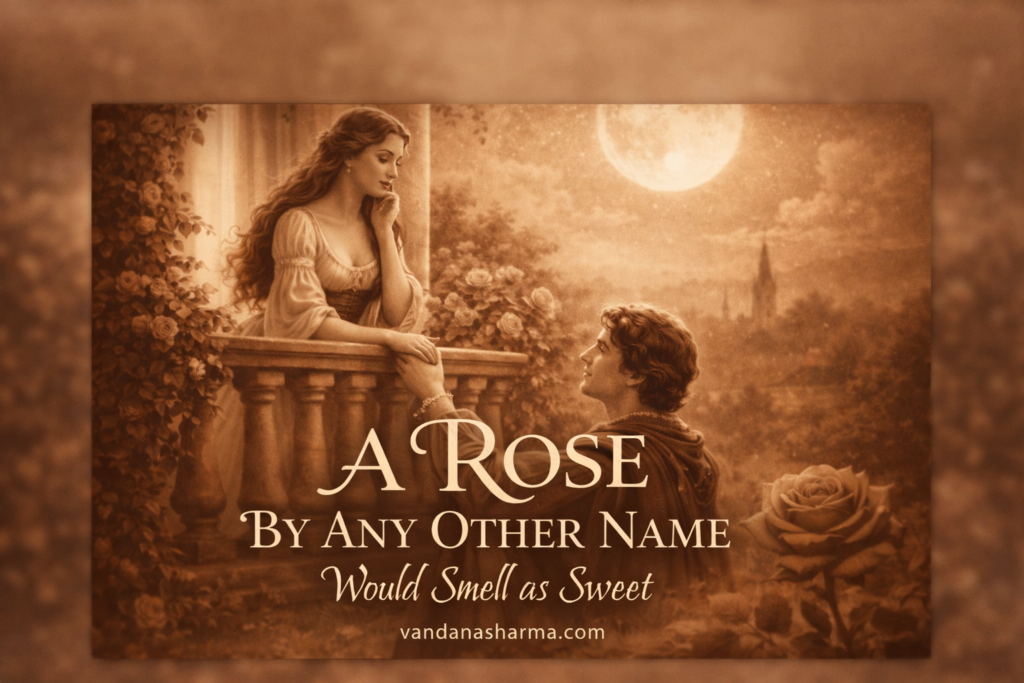
A Rose by Any Other Name
In the soft glow of a moonlit balcony, Juliet begins to question something most people never dare to: can a name truly define a person? Beneath that simple question lies one of Shakespeare’s most enduring ideas, captured in the line, “a rose by any other name would smell as sweet.”
Romeo is a Montague. Juliet is a Capulet. Their families have been locked in a bitter feud for so long that even the reason for it feels forgotten, though the hatred remains very much alive. In such a world, a name is not merely a word; it is a boundary, a warning, almost a sentence passed down through generations.
And yet, their love begins in complete innocence of these divisions. At a lively gathering in the Capulet household, Romeo slips in disguised among masked guests. There, in the midst of music and movement, he sees Juliet and is instantly drawn to her. They speak, share a moment of unspoken understanding, and are carried forward by an immediate, almost effortless connection. They even share a kiss, still unaware of the identities that should keep them apart.
Only afterwards the reality unfolds itself; the names surface and the lines are drawn.
Juliet’s anguish finds voice in a sudden realisation: “My only love sprung from my only hate! / Too early seen unknown, and known too late!” Love arrives first, unguarded and sincere; identity follows, burdened with conflict.
She cannot hate him for being a Montague, because her love was born before she knew the name that should have made him her enemy.
And so, Juliet begins to challenge the very idea of names. To her, a name is only a word. It cannot alter the truth of what something is. A rose would still carry its fragrance, even if it were called by another name. Its essence would remain untouched. In the same way, Romeo does not become less worthy of love because of the name he bears.
This is what gives the line its lasting power. It gently reminds us that names and labels, though powerful, are not the essence of things. They shape perception, but they do not create reality. A rose remains a rose, no matter what we call it.
And perhaps that is Shakespeare’s gentle challenge to the world. Love, beauty, and character exist beyond names. They cannot be reduced to labels or confined by language. Like the fragrance of a rose, they simply exist, unchanged and undeniable.