The 2026 ‘Wuthering Heights’ and the Undoing of Emily Brontë’s Vision
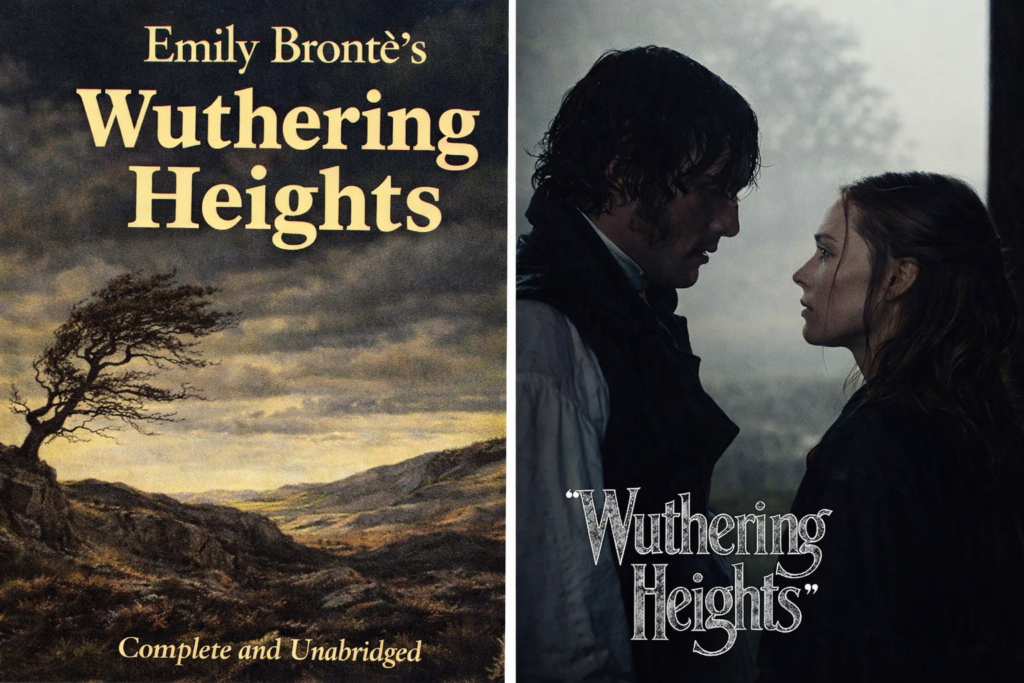
Devastation, Not Adaptation
As someone who has spent decades reading and teaching the classics, I approached the newly released 2026 film adaptation of Wuthering Heights with curiosity and cautious hope. Emily Brontë’s novel is not merely a love story; it is one of the most unsettling and psychologically complex works in English literature. Any attempt to bring such a work to the screen inevitably invites comparison with the original.
What unfolded on the screen, however, felt less like an adaptation and more like a dismantling of the novel’s spirit. As the film progressed, an irrepressible thought arose: had Emily Brontë been alive today, she might well have demanded an explanation for the liberties taken with the world she so carefully created.
The difficulty begins with the film Wuthering Heights fundamental misunderstanding of the central relationship. In Brontë’s novel, the bond between Catherine Earnshaw and Heathcliff is not merely romantic; it is metaphysical, psychological, and almost elemental in its intensity. Catherine’s famous declaration that Heathcliff is more herself than she is expresses a strange union of souls rather than a conventional love story. The film, however, appears determined to substitute psychological intensity with overt sensuality, reducing what in the novel is a profound emotional tragedy into little more than a succession of physical encounters. In doing so, it strips the relationship of the mysterious depth that makes Brontë’s narrative so haunting.
Such a transformation inevitably distorts Catherine’s character. In the novel she is never presented as a woman governed by sensual impulse. Her tragedy lies not in bodily passion but in a divided spirit: she is torn between social ambition and the fierce, almost elemental attachment she feels toward Heathcliff. By recasting this conflict in terms of physical indulgence and repeated transgressions, the film diminishes a character whose complexity lies in the turbulence of her inner life.
Particularly troubling is the film’s portrayal of Catherine after her marriage to Edgar Linton. In Brontë’s Wuthering Heights, Catherine’s marriage represents a tragic compromise with social respectability rather than a continuation of illicit intimacy with Heathcliff. The film, however, introduces encounters between the two even after Catherine’s marriage, and at a time when she is expecting a child. Such inventions reduce what in Brontë’s novel is a tragedy of the mind to something resembling sensational melodrama.
The reinterpretation of Isabella Linton’s story is similarly disquieting. In the novel Isabella’s marriage to Heathcliff springs from youthful infatuation and romantic illusion, only to lead her into a life of cruelty and degradation. The film does retain Heathcliff’s brutality toward her, yet the manner of its depiction veers toward disturbing spectacle. In one scene she is discovered chained and forced to behave like a dog under Heathcliff’s command. While a filmmaker may choose different ways of portraying Heathcliff’s cruelty, the persistent emphasis on grotesque and suggestive imagery once again shifts the tone away from psychological horror and toward a more superficial spectacle.
The architecture of the story itself is also altered. In Brontë’s narrative, Mr. Earnshaw brings the orphaned Heathcliff from Liverpool and raises him with a tenderness that provokes the jealousy of his son Hindley. Hindley’s resentment becomes one of the forces shaping Heathcliff’s later vengeance. The film blurs these relationships, weakening the emotional logic that underlies the original tragedy.
Equally surprising is the treatment of Nelly Dean. In the novel Wuthering Heights she serves as the principal storyteller, the observant voice through which the history of the Earnshaw and Linton families unfolds. Though not entirely impartial, she remains essentially a witness to the events rather than their architect. The film instead hints that she may be the illegitimate daughter of Mr. Earnshaw and presents her as a manipulative presence behind much of the unfolding disaster. Such a transformation alters not only her character but the narrative foundation of the story itself.
Even the pivotal events of the novel are reshaped. Catherine’s death in Brontë’s work occurs after the birth of her daughter, Cathy, and carries immense symbolic resonance within the narrative. The film replaces this moment with an invented abortion, thereby altering the emotional meaning of her fate.
The second generation narrative, which Brontë carefully constructs to suggest the possibility of renewal after devastation, is likewise mishandled. In the novel the eventual union between Cathy Linton and Hareton Earnshaw offers a fragile reconciliation after the bitterness of the previous generation. The film’s treatment of these relationships is confused and inconsistent, losing the sense of moral restoration that the novel quietly prepares.
Perhaps the most puzzling invention appears at the very beginning of the film. It opens with a public execution in which a man is hanged before a cheering crowd, while Catherine stands among the spectators with Nelly Dean. The moment is staged not merely as an execution but as a spectacle charged with unsettling and suggestive imagery. Such an episode finds no place in Brontë’s novel, and its narrative purpose remains difficult to discern. The film even returns to this motif later when Isabella expresses a curious eagerness to witness such public executions herself. Rather than deepening the psychological world of the story, these additions introduce a sensational tone that sits uneasily beside Brontë’s carefully constructed Gothic atmosphere.
Still more troubling are the film’s additional sensational inventions. Scenes involving Joseph and Zillah are transformed into bizarre sexual encounters entirely absent from the novel. Catherine’s voyeuristic observation of such behaviour, followed by her own awakening of physical curiosity, appears designed less to deepen character than to provoke shock. The austere Gothic atmosphere of the Yorkshire moors, so central to the identity of the novel, is displaced by a relentless emphasis on explicit spectacle.
The absence of Mr. Lockwood is also notable. In the novel he functions as the frame narrator through whose curiosity the strange history of Wuthering Heights gradually comes to light. A filmmaker may reasonably choose to streamline this narrative device, yet his disappearance removes an important layer of perspective from the story.
Even the visual characterisation of certain figures seems curiously inverted. Heathcliff, whose dark and foreign appearance in the novel marks him as an outsider, is presented here without that ambiguity, while Edgar Linton, traditionally the embodiment of refinement and gentility, is portrayed as a wealthy gentleman yet depicted with a noticeably different racial appearance. Such choices blur the contrasts that Brontë so carefully established between civilisation and wildness.
Watching the film in an almost empty theatre, only one other viewer sat several rows ahead, I could not help reflecting on the curious distance between Brontë’s creation and its cinematic reinterpretation. The novel’s Gothic intensity, its psychological turbulence, and its haunting sense of place seem largely absent. In their place stands a spectacle driven primarily by sensation.
For comparison, the 1992 film adaptation starring Ralph Fiennes and Juliette Binoche remains considerably closer to the spirit of the novel. While no adaptation can capture every nuance of Brontë’s intricate narrative, that version at least preserves the essential structure of the two generations and the sombre atmosphere of the moors.
The 2026 film, by contrast, borrows the names of Brontë’s characters while abandoning the philosophical and emotional architecture that sustains them. What emerges is not an interpretation of Wuthering Heights but something altogether different.
In the end, the experience serves as a reminder that great literature possesses its own inner integrity. The wild emotional landscape that Emily Brontë created cannot simply be replaced by spectacle without consequence. When the psychological storm at the heart of the novel is stripped away, what remains may still carry the names of Brontë’s characters, but the living spirit of Wuthering Heights has quietly vanished.